For decades, the insurance industry drew a hard line between two distribution models.
On one side stood the Captive Giants—armed with multi-billion-dollar national ad budgets, prime-time television commercials, and a standardized army of dedicated agents. On the other side stood the Independent Network—flexible, carrying a vast product catalog from tier-one carriers like Mercury, Progressive, and Travelers, but historically fighting an uphill battle against the sheer volume of captive corporate noise.
But a fundamental shift in consumer search mechanics has completely flipped the script.
Today, massive national ad spend is hitting a wall of diminishing returns. The modern insurance buyer doesn't care about a catchy corporate jingle; they care about their immediate geographic community. For independent carriers and their agent networks, this shift represents a massive market arbitrage opportunity.
By weaponizing hyper-local, community-insider content, independent agents are quietly out-localing captive giants and winning high-value zip codes right from under their noses.
The Death of the Generic Search
For years, the play for national carriers was simple: bid on massive, broad keywords like "best auto insurance companies" or "top 10 cheapest carriers."
But consumer behavior has fundamentally adapted. High-intent buyers are shifting away from national aggregates and focusing heavily on proximity. Mobile queries containing "insurance near me" have sustained a 100%+ year-over-year growth rate based on long-term Google Consumer Insights.
More importantly, proximity-based searches carry an incredibly compressed sales cycle. Google's behavioral data shows that 76% of consumers who conduct a localized "near me" search interact with a related business within 24 hours, and 28% of those interactions result in an immediate purchase.
[Captive Model]: National Brand Ads ──> High Funnel Friction ──> Consumer Drop-off
[Independent Model]: Hyper-Local Content ──> Immediate Proximity Trust ──> 76% Interaction Within 24 Hours
When a consumer searches for an agent in their specific town, they aren't looking for a sterile corporate landing page managed from a headquarters thousands of miles away. They are looking for a local authority. Furthermore, with Google Search Data confirming that 46% of all daily Google searches carry explicit local intent, independent agents who populate their digital footprint with community news, local business spotlights, and regional risk factors align perfectly with modern localization algorithms. They instantly bypass the multi-million-dollar defensive ad spend of captive competitors.
The Digital Front Door Requires a Human Hand
There is a common misconception among corporate marketing executives that the insurance journey has become completely automated and digital-only. The data says otherwise.
According to data published via the J.D. Power U.S. Insurance Digital Experience Study, digital channels have become the official majority front door for customer acquisition, with 47% of new auto and home insurance policies now being purchased or initiated entirely through digital channels. However, the remaining 53% still require direct human interaction to finalize, cross-sell, and close the policy.
Worse for national brands, the 2026 J.D. Power digital experience benchmarks highlight that overall consumer satisfaction with major carrier websites and mobile apps has actually declined. Customer satisfaction scores on insurer websites and apps fell a steep 12 points in the shopping segment (down to 523 on a 1,000-point scale) as consumers increasingly struggle to navigate complex coverage and rate variables through rigid corporate interfaces.
This is where the independent agent holds an unassailable competitive advantage.
47% of Policies Start Digitally ──> Over 50% Still Need a Local Human to Close
Captive agents are bound by rigid corporate scripts and highly restricted brand parameters. They cannot easily pivot their marketing to address a specific neighborhood zoning change, a localized weather trend, or a new regional commercial development.
An independent agent using a community-insider model bridges the digital-to-human gap perfectly. Their content serves as the trusted, digital front door for consumers who use search engines specifically to seek out hyper-local business information and find a guide they can actually trust.
The Trust Arbitrage: Why "Local" Beats "National"
Brand loyalty in the P&C (Property and Casualty) space is at a historic turning point. Comprehensive historical market data highlights a staggering surge in policy churn: the percentage of customers actively shopping their auto insurance reached an all-time record of 57%, and an unprecedented 29% of customers actually switched carriers when faced with compounding rate pressures, as detailed in the J.D. Power Insurance Intelligence Report.
When a market is this volatile, broad national branding loses its grip. Trust becomes the only stable metric for retention. Consumer trust studies show that 50% of consumers explicitly trust localized content and regional businesses more than broad corporate messaging, and 56% of buyers directly associate a visible, highly active local presence with superior service quality.
A captive agent represents one single corporate entity. If that carrier's rates fluctuate or their underwriting guidelines tighten, the agent's local authority is completely handcuffed.
An independent agent, conversely, positions themselves as the consumer's local advocate. By producing high-value content centered around the community's actual interests—rather than dry insurance policy jargon—they build a deep reservoir of local trust. If a carrier's rate structure shifts, the independent agent doesn't lose the client; they simply re-market the client to another tier-one carrier in their portfolio, retaining the book of business locally.
The Playbook for Independent Carriers
For independent insurance companies like Mercury, Progressive, or Travelers, the mandate is clear: You cannot win the local war from corporate headquarters.
Your corporate ad budgets should build the baseline product authority, but your independent agent network must be armed to capture the local intent.
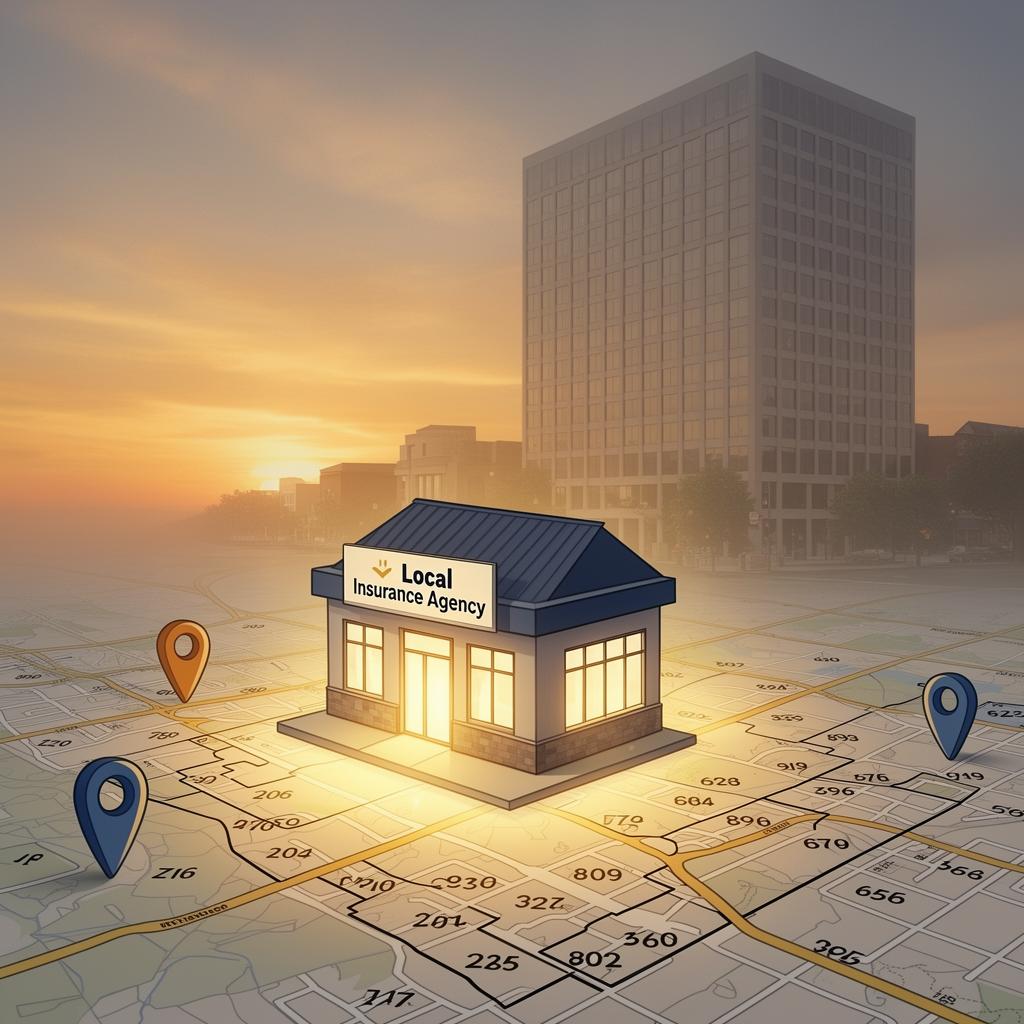
When carriers incentivize and enable their independent agents to stop posting generic corporate flyers and start publishing dynamic, hyper-local community content, they unlock an organic distribution network that no captive giant can match. The battle for market share is no longer won on national television—it is won zip code by zip code, screen by screen, in the communities your agents call home.